

A winter break can look simple on the fixture list: a few weeks without competitive football, followed by a return to league action. But from a tactical and performance perspective, the effect is considerably more complex.
For teams competing across demanding domestic and continental schedules, a mid-season pause can provide valuable recovery time while simultaneously disrupting competitive rhythm. Players may return physically refreshed, but passing speed, repeated-sprint ability, tactical automatisms and match sharpness do not necessarily return at the same rate.
This makes the winter break an important factor when analysing major football matches, particularly when interpreting post-break results, tactical changes and pre-match expectations.
For Indian football followers, the subject is increasingly relevant. The Indian Super League (ISL) and other domestic competitions operate within different calendar structures from many European leagues, but the underlying performance question remains the same: what happens to a football team when competitive intensity suddenly stops?
Why the Winter Break Matters in Modern Football
Modern football places significant physical demands on players. A team may have to combine domestic league matches with cup fixtures, continental competitions, international travel and training requirements.
A break therefore has two competing effects.
The first is recovery. Players have more time to recover from accumulated fatigue, minor muscular problems and the psychological pressure of continuous competition.
The second is detraining and loss of competitive rhythm. When high-intensity football disappears for an extended period, certain match-specific abilities can decline.
Research examining European leagues provides useful evidence. A study covering 3,494 team-match observations from the Bundesliga, La Liga, Ligue 1 and Premier League across five seasons found that the effect varied substantially according to the length of the break. The German Bundesliga, where the average break was approximately 32 days, showed significant declines in 13 of 21 shooting-performance measures after the break. Ligue 1, with an average break of around 19 days, showed deterioration in four of 17 passing measures. By comparison, La Liga’s average 13-day break did not produce significant technical changes in the study.
This suggests that the question is not simply whether teams should rest. The more important question is how long the rest lasts and how the team uses it.
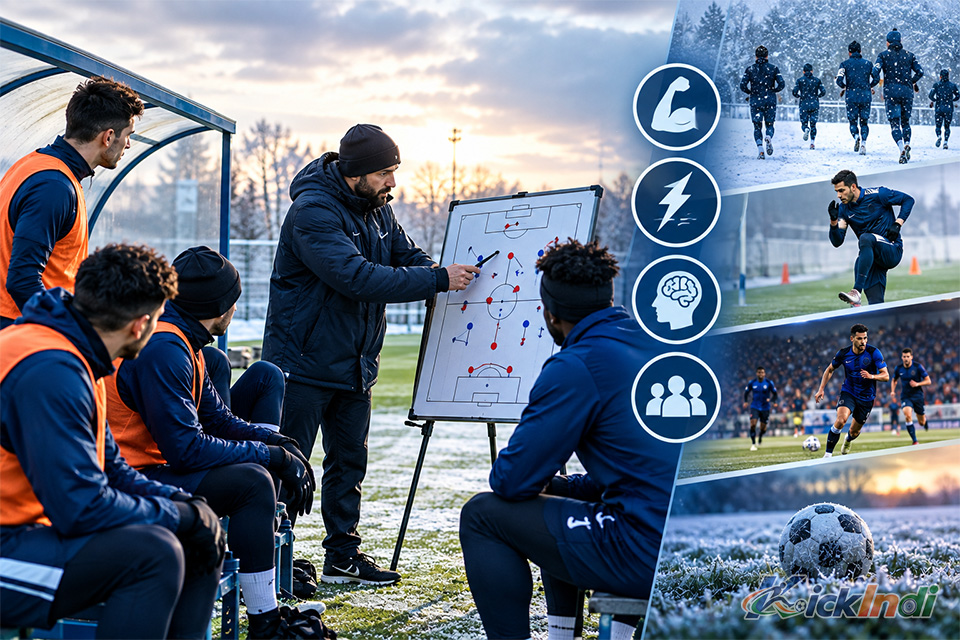
How Winter Break Affects Football Team Performance
The most important issue when analysing how winter break affects football team performance is the balance between recovery and rhythm.
A well-managed break can allow coaching staffs to reduce physical fatigue and address tactical weaknesses. Players can return with greater freshness, while coaches have additional time to review previous performances and prepare tactical adjustments.
However, competitive football involves highly specific physical actions. Sprinting, pressing, rapid changes of direction and repeated high-intensity movements are not identical to ordinary fitness training.
A controlled scientific study involving professional and elite young footballers found that two weeks of in-season detraining reduced repeated-sprint performance. At the same time, intermittent endurance measured through the Yo-Yo test did not change significantly.
That distinction is particularly important.
A player can therefore appear physically fit while still being less effective during repeated explosive actions. In a competitive match, this can influence:
- pressing intensity;
- recovery runs;
- defensive transitions;
- attacking counter-movements;
- late-game acceleration;
- ability to repeat high-speed actions.
For analysts, the first matches after a break should therefore not be judged only through possession or final score. The underlying physical profile can reveal a more complicated picture.
The Impact of Mid-Season Rest on Football Teams
The impact of mid-season rest on football teams is also strongly connected to tactical continuity.
Football systems depend on repeated movements between players. A high press, for example, requires forwards, midfielders and defenders to move almost simultaneously. If one player presses slightly late, an opponent can exploit the gap.
After a long break, this collective timing can require several competitive matches to return to its previous level.
The same applies to build-up play. Teams that rely on short passing combinations may initially show slower circulation or more misplaced passes. Counter-attacking teams may experience a different problem: the first pass after winning possession may be accurate, but supporting runners may not accelerate at the same time.
These small differences can alter the entire tactical profile of a match.
Interestingly, the European study found that breaks shorter than approximately 13 days did not appear to produce the same technical disruption as longer breaks. The researchers concluded that longer interruptions can contribute to a loss of momentum, although the relationship is not universal across leagues.
This is why analysts should avoid treating every winter break as identical.

Real Data: What Happens After a Mid-Season Break?
The following figures provide a useful evidence base for understanding the relationship between break length and technical performance.
| Competition | Average Break | Observed Post-Break Effect |
| Bundesliga | 32 days | Significant decline in 13 of 21 shooting measures |
| Ligue 1 | 19 days | Significant decline in 4 of 17 passing measures |
| La Liga | 13 days | No significant technical effect detected |
| Premier League | No winter break in study period | No comparable winter-break effect |
Source: study of 3,494 team-match observations across five European leagues/seasons.
The table should not be interpreted as proof that a long break automatically causes poor results. Football performance is influenced by injuries, transfers, opposition quality, tactical changes, fixture difficulty and many other variables.
Instead, the data indicate that break duration can be an important contextual variable.
For prediction models and post-match commentary, this means the number of days since a team’s previous competitive match can be worth monitoring alongside xG, possession, shots, pressing statistics and defensive actions.
How Winter Break Changes Football Team Performance
Understanding how winter break changes football team performance requires looking beyond fitness.
One of the clearest examples comes from Arsenal’s 2024 winter break. Following their training camp in Dubai, Arsenal won four consecutive Premier League matches, scoring 16 goals. Their goals-per-game average across those four matches was 4.0, compared with 1.9 across their first 20 league matches. Their xG average also increased from 1.9 to 2.9.
However, attributing that improvement entirely to rest would be misleading.
Arsenal also made tactical adjustments. Declan Rice became more involved in set pieces, while Kai Havertz was used in different attacking roles. The break therefore provided not only recovery but also an opportunity for tactical preparation.
This is a crucial lesson for Match Commentary analysis.
A winter break should be viewed as a strategic reset period, not merely a holiday.
A coaching staff can use the interruption to:
- review weaknesses from the first half of the season;
- modify pressing structures;
- change player positioning;
- rehearse set-piece routines;
- manage injured players;
- improve squad cohesion;
- prepare specifically for upcoming opponents.
Consequently, a team’s post-break improvement may result from several factors operating simultaneously.
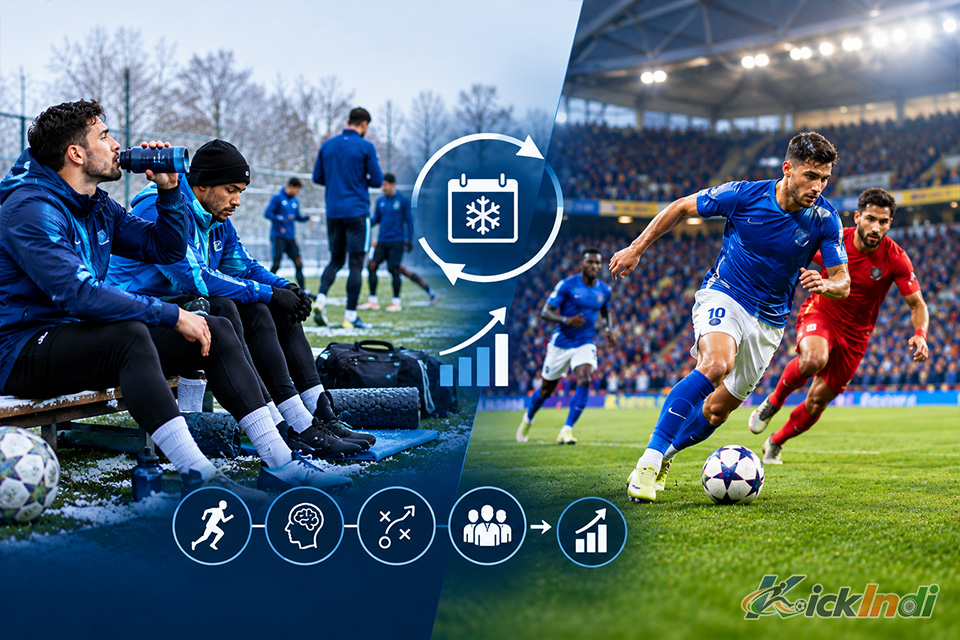
Tactical Rhythm Versus Physical Recovery
There is a fundamental tactical trade-off between freshness and rhythm.
A team that has played regularly may have superior match sharpness. Its players are accustomed to the speed of decision-making, while its positional relationships remain automatic.
A rested team may have more physical energy but require time to regain those automatisms.
This is particularly important during the opening 15–20 minutes after a long break.
Analysts should examine whether a team:
- starts cautiously;
- presses less aggressively;
- takes longer to build attacks;
- makes more unforced technical errors;
- produces fewer progressive passes;
- concedes territory early.
The answers can reveal whether the team is still rebuilding competitive rhythm.
For Indian clubs, this is especially relevant when analysing matches around changes in the ISL fixture schedule or extended interruptions. The official ISL schedule provides match dates and competition information that can be used to calculate each team’s rest period before individual fixtures.
Mid-Season Break Impact on Football Match Results
The mid-season break impact on football match results is difficult to isolate because the break itself is rarely the only variable that changes.
A team may return from a break and immediately face a league leader. Another may receive a comparatively favourable fixture. Some squads may gain injured players while others lose important starters.
Therefore, analysts should compare several indicators rather than simply asking whether a team won or lost.
A useful post-break framework includes:
1. Result: win, draw or defeat.
2. Chance creation: shots, shots on target and expected goals.
3. Possession efficiency: whether possession actually produces meaningful attacking opportunities.
4. Transition performance: how quickly the team moves from defence to attack.
5. Pressing: whether intensity returns to the pre-break level.
6. Defensive concentration: especially during the final 15 minutes.
This approach helps separate genuine performance changes from results driven primarily by finishing variance or individual errors.
What Indian Football Analysts Should Watch
For Indian football audiences, winter-break analysis should also consider the differences between European and Indian competition calendars.
The ISL has its own scheduling structure, while European leagues may experience substantially longer interruptions. Therefore, conclusions from the Bundesliga or Ligue 1 should not automatically be transferred to Indian clubs.
Instead, KickIndi readers can use the same analytical principles when evaluating Indian football matches.
Before a major fixture, check:
- number of rest days since the previous competitive match;
- whether the squad has travelled extensively;
- availability of key players;
- changes to the starting XI;
- recent pressing intensity;
- first-half scoring patterns;
- second-half physical output;
- tactical changes introduced during the break.
These variables can provide additional context when reading match odds and expert predictions.
The Betting and Prediction Angle
The winter break can also influence how football markets are interpreted.
A team’s pre-break record may not perfectly represent its post-break performance level. If tactical roles have changed or important players have returned from injury, historical results may have reduced predictive value.
At the same time, analysts should avoid assuming that a rested team will automatically outperform its opponent.
For prediction purposes, the more useful question is:

Has the team converted its additional preparation time into measurable performance improvements?
Evidence such as increased xG, improved shot quality, stronger pressing numbers or fewer defensive errors is more informative than simply saying that players are “fresh”.
For football betting analysis, this distinction is important because public expectations can sometimes focus heavily on recent results rather than the underlying performance indicators.
Conclusion: Rest Is an Opportunity, Not a Guarantee
The winter break creates a unique tactical and physical environment.
Research suggests that longer interruptions can affect technical performance, while controlled studies have also demonstrated that two weeks of in-season detraining can reduce repeated-sprint ability.
Yet the break can also give coaches time to recover players, redesign tactical structures and prepare for specific opponents. Arsenal’s post-break improvement in 2024 illustrates how recovery and tactical intervention can work together rather than independently.
For Match Commentary, the key lesson is straightforward: do not analyse the first match after a winter break through the final score alone.
The most meaningful assessment combines rest duration, physical output, tactical continuity, squad availability, chance creation and the quality of the opposition.
For Indian football fans following the ISL and international competitions, this provides a stronger framework for understanding why two teams with similar pre-break records can look completely different when competitive football resumes.
The winter break does not automatically make a team stronger or weaker. Its real effect depends on what happens during the break—and how effectively the team converts recovery time into competitive performance.



































 England

 Spain

 Italy

 Germany
 France

 Netherlands

 Portugal
 Brazil

 Belgium
Real need to be more consistent Bundesliga has its own unique style and if they can stay injury-free 💭
Bundesliga is the best league in the world Loved it with the talent they have