

In modern football, the centre-back is no longer judged only by tackles, clearances and aerial duels. The best defenders are increasingly expected to control the first phase of possession, resist pressing, break defensive lines and still make the decisive intervention when an opponent reaches the penalty area.
This evolution is particularly relevant when analysing Indian football and the Indian Super League (ISL). As more teams seek controlled build-up play and structured possession, centre-backs have become important tactical reference points rather than simply the last line of defence.
The central question, therefore, is not whether a centre-back should be a defender or a passer. It is how effectively both skill sets can work together.
What Makes an Elite Centre-Back in Modern Football?
The key qualities of an elite football center-back begin with the traditional fundamentals: positioning, anticipation, tackling, aerial ability, physical strength and concentration. These remain essential regardless of whether a team plays a high defensive line, a mid-block or a deep defensive structure.
However, elite-level performance now requires additional qualities.
A modern centre-back must understand when to step forward, when to hold the defensive line and when to protect the space behind the full-backs. With possession, he must recognise pressing triggers, identify passing lanes and select the appropriate level of risk.
This is why reading the game is often more valuable than simply making spectacular tackles.
An intelligent centre-back can prevent a dangerous situation before a tackle becomes necessary. By anticipating a forward pass, adjusting his body position and controlling the space between himself and the striker, he can eliminate the attack at an earlier stage.
The same principle applies when the team has the ball. A centre-back who receives possession under pressure and plays forward accurately can prevent the opposition from establishing an effective press.
In other words, elite defending is increasingly about controlling situations rather than merely reacting to them.
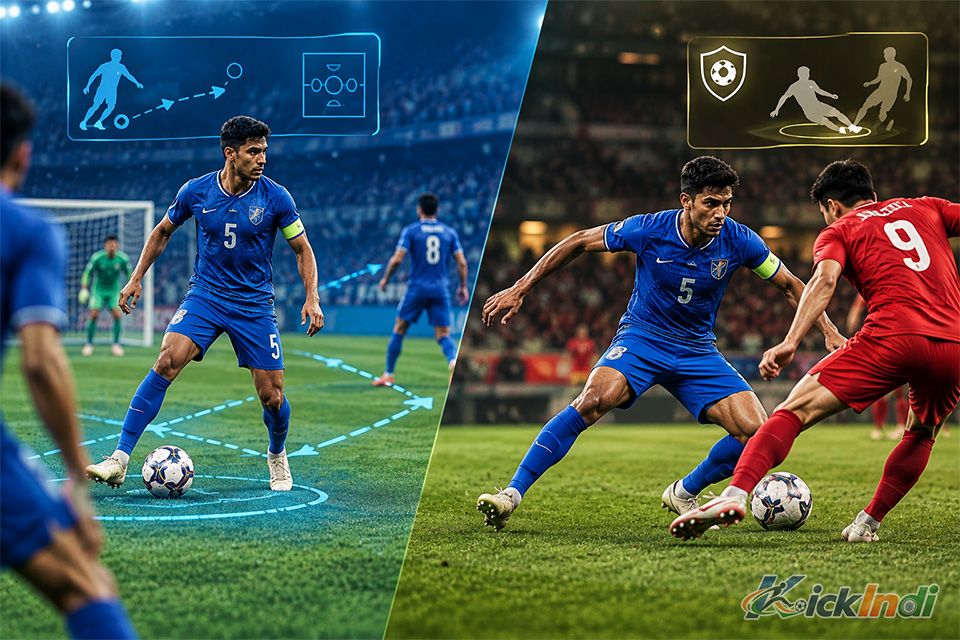
Ball-Playing Ability: More Than Accurate Passing
The term “ball-playing centre-back” is sometimes misunderstood as simply referring to a defender who has a high passing percentage.
In reality, ball-playing ability includes several interconnected skills: first touch, scanning, body orientation, passing range, progressive passing, ball carrying and decision-making under pressure.
A centre-back may complete 95% of his passes but still contribute little to attacking progression if most of those passes are short and lateral.
The more important question is what those passes achieve.
Can the defender attract an opponent before releasing the ball? Can he find the midfielder between the lines? Can he switch play towards an isolated winger? Can he carry the ball beyond the first pressing line when no passing lane is available?
These actions change the structure of the match.
Modern tactical analysis increasingly recognises that centre-backs can influence attacking phases through their positioning and distribution. Their movement can create passing angles for midfielders and full-backs, while a well-timed forward pass can immediately change the location of the opposition’s defensive block.
How Ball-Playing Centre-Backs Improve Modern Football Tactics
Understanding how ball-playing center-backs improve modern football tactics requires looking beyond individual passing statistics.
Imagine an opponent using a 4-4-2 press. Two forwards attempt to prevent easy access into midfield. If both centre-backs simply pass sideways, the opposition can maintain its defensive shape.
But if one centre-back carries the ball forward, an opposing midfielder may be forced to leave his position.
That creates a tactical chain reaction.
The midfielder who moves forward opens space behind him. A defensive midfielder can then receive the ball. A full-back may move higher, while a winger can attack the space outside the opposition full-back.
One centre-back’s decision has therefore changed the positioning of five or six other players.
This is one reason possession-oriented teams increasingly value defenders who are comfortable progressing the ball. Tactical analysis of modern centre-backs highlights their ability to influence build-up structure, tempo and the location of the team’s attacking platform.
For Indian teams, this can be especially useful against compact defensive blocks. When an opponent sits deep, there may be limited space for midfielders to operate. A centre-back who can step into midfield can create an additional passing option and force the defensive block to react.
The benefit is not simply possession for possession’s sake. It is positional manipulation.

Defensive Instincts Still Decide the Biggest Moments
Despite the evolution of the position, defensive instincts remain fundamental.
A centre-back can have outstanding distribution and still become a liability if he consistently misjudges danger. Defensive instincts involve anticipation, timing, positioning, awareness of runners and the ability to recognise when an opponent is about to attack the space behind the defensive line.
This becomes particularly important during major matches.
A team may dominate possession for 70 minutes, but one poorly judged step from a centre-back can produce a one-on-one opportunity. Conversely, a perfectly timed interception in the 85th minute can preserve a narrow lead.
This is why centre-backs must constantly balance aggression with restraint.
Stepping forward at the correct moment can stop an attack before it develops. Stepping forward at the wrong moment can create a large gap behind the defensive line.
The same principle applies to tackling. The objective is not to make the most tackles. The objective is to make the right defensive intervention.
Modern scouting frameworks therefore assess centre-backs across different defensive contexts, including high-line defending, penalty-area defending and contribution during possession phases.
Defensive Instincts vs Passing Ability: Which Matters More?
The debate around defensive instincts vs passing ability for football center-backs should not be treated as a simple choice between two opposing qualities.
Their importance depends on the team’s tactical model.
A side defending in a deep block may place greater practical emphasis on aerial defending, box positioning, clearances and one-versus-one defending. A possession-heavy side that consistently builds from the goalkeeper may demand much greater passing responsibility from its centre-backs.
But even in a possession-based system, defensive reliability cannot be sacrificed.
The ideal centre-back is therefore not necessarily the defender with the best passing range or the highest number of tackles. Instead, he is the player whose technical and defensive qualities fit the tactical demands of the team.
A useful way to evaluate a centre-back is to divide his performance into four areas:
- Defensive reliability – duels, interceptions, positioning and recovery actions.
- Build-up quality – passing accuracy, progression and resistance to pressing.
- Decision-making – selecting the correct action according to match context.
- Tactical adaptability – performing effectively against different formations and attacking structures.
This broader framework provides a more meaningful evaluation than looking at one statistic.

ISL Evidence: Centre-Back Passing Has Become Increasingly Important
The Indian Super League provides useful evidence of how defensive players contribute to possession.
According to the official ISL review of the 2024–25 season, several centre-backs and defensive players ranked among the competition’s leading successful passers. Mehtab Singh recorded 1,353 successful passes in 23 matches, while Rahul Bheke recorded 1,129 in 26 matches. Tiri completed 1,120 successful passes in 21 matches, and Tom Aldred completed 1,028 in 26 matches. Alberto Rodríguez recorded 981 successful passes in 22 matches.
| Player | Club | Matches | Successful Passes |
| Mehtab Singh | Mumbai City FC | 23 | 1,353 |
| Rahul Bheke | Bengaluru FC | 26 | 1,129 |
| Tiri | Mumbai City FC | 21 | 1,120 |
| Tom Aldred | Mohun Bagan Super Giant | 26 | 1,028 |
| Alberto Rodríguez | Mohun Bagan Super Giant | 22 | 981 |
These figures should not be interpreted as a direct ranking of the best defenders. Successful passes measure distribution volume, not the complete defensive contribution of a centre-back.
Nevertheless, the numbers demonstrate an important tactical trend: defenders are increasingly involved in maintaining possession and initiating attacks.
The ISL’s official statistics platform also tracks successful passes alongside defensive and team metrics such as interceptions, successful tackles and clean sheets, reflecting the multi-dimensional nature of modern player evaluation.
Reading Match Situations: The Difference Between Good and Elite
A centre-back’s true quality is often revealed during changing match situations.
Consider a team protecting a 1-0 lead late in a major fixture. The correct decision may be a controlled clearance rather than a risky forward pass.
Now consider the same team trailing 0-1 with 15 minutes remaining. The centre-back may need to carry the ball forward, attempt more progressive passes and support the midfield structure.
The technical action may be identical—a pass or carry—but the tactical value is completely different.
This is where decision-making becomes critical.
Elite defenders understand match state, scoreline, opponent behaviour and available space. They know that the safest action is not always a sideways pass, just as the most progressive action is not always the best one.
For analysts reviewing a match, these contextual decisions are often more revealing than raw possession statistics.

Tactical Evaluation for Match Commentary and Football Predictions
From a Match Commentary perspective, centre-backs deserve particular attention because their decisions can influence both the flow and outcome of a match.
Before evaluating a major fixture, analysts should consider:
- Does the opposition press the centre-backs aggressively?
- Can the defenders play through that pressure?
- Is the defensive line high or deep?
- How quickly can the centre-backs recover?
- Who protects the space in front of them?
- Can they defend crosses and second balls?
- Does the team have a reliable outlet when under pressure?
These factors can also influence how a match develops for viewers following football odds and predictions.
A team with excellent attacking players may still struggle if its centre-backs cannot progress the ball against pressure. Similarly, a possession-dominant side may become vulnerable if its defenders lack the defensive instincts required to protect a high line.
Therefore, centre-back analysis should be included when assessing expected match patterns rather than treating the position as a purely defensive statistic.
The Ideal Elite Centre-Back Profile
The modern elite centre-back is ultimately a hybrid footballer.
He must be strong enough to defend the penalty area, intelligent enough to anticipate danger, composed enough to receive the ball under pressure and technically capable enough to progress possession.
The balance between these characteristics will vary according to the coach’s system.
A team focused on controlled possession may require greater distribution and ball-carrying ability. A team relying on defensive transitions may place greater emphasis on recovery speed, duels and defensive positioning.
But the fundamental principle remains constant: ball-playing ability should enhance defending, not replace it.
The strongest centre-backs combine both sides of the position. They know when to step forward and when to stay back, when to play through pressure and when to remove danger, and when to take responsibility with the ball and when to choose the simple option.
For Indian football, the continued development of this complete centre-back profile could become increasingly important as tactical standards, coaching structures and match intensity continue to evolve.
In the biggest matches, one intelligent pass can break a press. One well-timed interception can stop a counter-attack. One positional mistake can decide the result.
That is why the modern centre-back is not merely the last defender.
He is often the first playmaker, the tactical stabiliser and one of the most important decision-makers on the pitch.

 England

 Spain

 Italy

 Germany

 France

 Netherlands

 Portugal
 Brazil

 Belgium
Mehtab Singh is overrated 🤔
Reading are the real deal this season Love what Reading are building 🔥