

Football is often described as a game of numbers. Recent form, expected goals, possession, shots, league position, home advantage and defensive records all provide useful clues about what may happen over 90 minutes.
Yet derby matches repeatedly challenge this logic.
A team that has won four consecutive matches can struggle against a rival sitting near the bottom of the table. A side with superior attacking numbers can suddenly become cautious. A normally reliable defence may concede from a set-piece or individual error. For supporters, these results may feel surprising. For analysts, however, derby football provides an important lesson: historical data describes probability, but rivalry can change the conditions under which that probability is expressed.
This is particularly relevant to Indian football, where fixtures such as the Kolkata Derby, Bengaluru FC vs Kerala Blasters and Chennaiyin FC vs Bengaluru FC carry significance beyond league points. The Indian Super League itself recognises that rivalries can be driven by geography, history, fan culture and the desire for bragging rights.
So, why do derby matches behave differently from ordinary league fixtures?
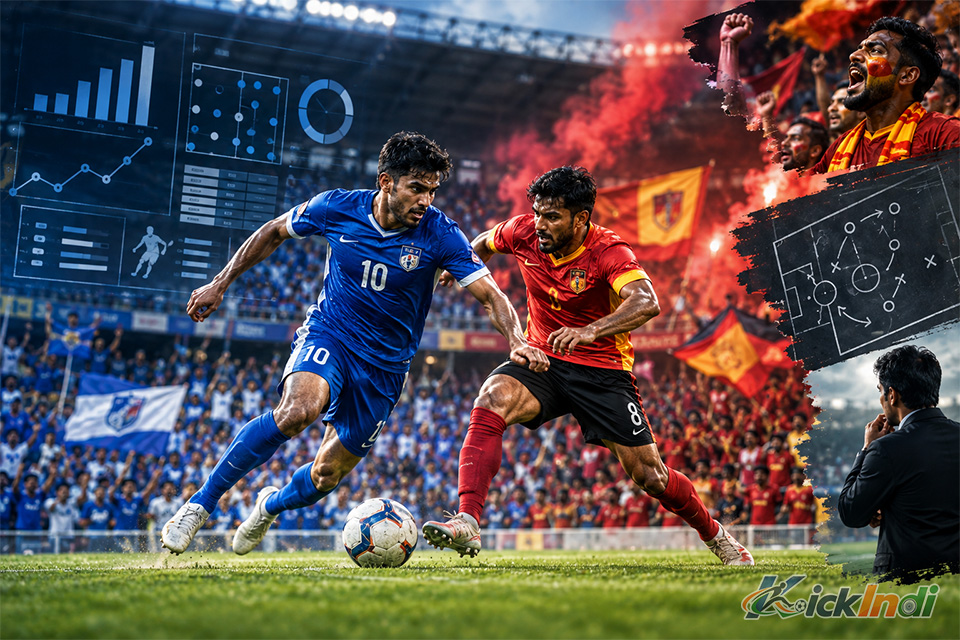
Why Derby Matches Defy Form and Statistics
The first reason is that a derby is rarely treated as an ordinary fixture by players, coaches or supporters.
In a normal league match, the difference between two teams may be reasonably represented by their recent performances. If Team A has produced stronger attacking numbers, conceded fewer goals and collected more points, it would normally enter the match with a statistical advantage.
A derby can reduce the practical value of that advantage.
The psychological environment changes decision-making. Players may accept greater physical risk, press more aggressively and attempt actions they would avoid in a conventional fixture. Coaches may also modify their tactical plans because losing to a rival can have a different emotional and reputational impact from losing to another opponent.
This helps explain why derby matches defy form and statistics without suggesting that statistics become useless.
Instead, the correct interpretation is that statistics need context.
Recent form remains relevant. Expected goals remain relevant. Squad quality remains relevant. But their predictive power may be affected by variables that are difficult to measure consistently, including emotional intensity, crowd pressure, tactical conservatism and the importance attached to avoiding defeat.
Academic research also shows that home advantage remains a significant feature of professional football, although its influence has declined over time. A study covering English professional football from 1974 to 2018 found an average absolute home advantage of approximately 0.59–0.64 points per game and a goal-difference advantage of roughly 0.44–0.46 goals.
A derby introduces another layer: the home crowd is not merely watching a match; it is participating emotionally in a contest involving local identity.
How Rivalry Changes Tactical Behaviour
The tactical structure of a derby often reveals why pre-match models can struggle.
1. More conservative opening phases
A coach may normally encourage aggressive pressing from the first minute. Against a major rival, however, conceding early can be considered especially damaging.
This can produce a more controlled first 15–20 minutes, with both teams protecting central areas and avoiding unnecessary defensive risks.
The result may be fewer early chances than expected.
2. Greater importance of transitions
Derbies can become unusually sensitive to turnovers.
When emotional intensity increases, midfielders may attempt quicker vertical passes and defenders may step forward more aggressively. One misplaced pass can therefore create a transition opportunity.
This makes counter-attacking football particularly important.
A technically superior team may dominate possession but still struggle if its opponent is comfortable defending compactly and attacking the space behind the full-backs.
3. Set-pieces become critical
When open-play opportunities are limited, corners, free-kicks and long throws gain additional importance.
A single delivery can change the entire tactical structure of the match. The team that scores first can then protect its advantage through deeper defending, slower restarts and controlled possession.
For post-match analysis, this is why analysts should not focus exclusively on possession percentage or total shots.
The question should also be:
Where did the decisive chances come from?
How Rivalry Affects Football Match Predictions
Understanding how rivalry affects football match predictions requires separating statistical probability from match-day conditions.
A prediction model may use recent results, expected goals, injuries, home advantage and historical strength. These variables are useful because they provide measurable information.
But a derby can create a wider range of plausible outcomes.
Consider two teams with a significant difference in league position. In an ordinary fixture, the stronger side may be expected to control territory and generate more opportunities.
In a derby, the weaker team may compensate through:
- higher defensive intensity;
- more aggressive duels;
- compact defensive positioning;
- direct counter-attacks;
- greater emotional commitment;
- increased set-piece focus.
None of these factors automatically guarantees an upset. Instead, they can reduce the gap between the two sides.
This is why derby analysis should avoid statements such as “Team A is clearly better because it has won its last five matches”.
A better analytical approach is to ask:
What happens when Team A’s preferred style meets Team B’s derby-specific strategy?
That question moves the analysis from simple form comparison towards tactical evaluation.

Why Form Matters Less in Football Derby Matches
The phrase why form matters less in football derby matches needs careful interpretation.
Form does not suddenly disappear because two clubs are rivals.
Rather, its predictive weight can become less reliable when the match environment changes.
Suppose one team has scored 14 goals across its previous five matches. That record demonstrates attacking efficiency. But if its derby opponent sits deeper, closes passing lanes and refuses to allow space behind the defensive line, the attacking team may not reproduce its previous chance creation.
Similarly, a team that has conceded frequently in recent matches may defend much more compactly in a derby.
The tactical context is therefore more important than the raw form line.
There is also a selection effect. Coaches may prepare differently for a derby. Players who were rotated during previous league fixtures may be selected specifically for their defensive work rate, physical strength or experience in high-pressure matches.
In other words, recent results describe what happened before the derby; they do not necessarily describe how both teams will approach the derby itself.
Indian Football: Why Derby Context Matters
This principle is especially useful when analysing Indian football.
The Indian Super League has developed several rivalries in which geography, supporter culture and club history contribute to the intensity of the fixture. The league has highlighted the Kolkata Derby between Mohun Bagan Super Giant and East Bengal FC, as well as rivalries involving Kerala Blasters, Bengaluru FC and Chennaiyin FC.
The Kolkata Derby is an obvious example. The rivalry between Mohun Bagan and East Bengal dates back to 1921, making it considerably older than the modern ISL era.
The Southern rivalries offer another useful case. Chennaiyin FC, Kerala Blasters FC and Bengaluru FC have developed intense contests influenced partly by geographical proximity and supporter culture.
These fixtures demonstrate why Indian football analysis should not simply import a generic statistical model without considering local context.
The crowd, travel patterns, stadium atmosphere, rivalry history and expectations surrounding a match can all affect the tactical environment.
What the Numbers Actually Tell Us
Statistics remain extremely valuable, provided they are interpreted correctly.
For example, Premier League data from the 2021-22 to 2024-25 seasons shows that home teams won 44.5% of matches on average, while draws accounted for 23.0% and away wins for 32.4%. The figures fluctuate considerably between seasons.
| Premier League Season | Home Wins | Draws | Away Wins | Home Win % |
| 2021-22 | 163 | 88 | 129 | 42.9% |
| 2022-23 | 184 | 87 | 109 | 48.4% |
| 2023-24 | 175 | 82 | 123 | 46.1% |
| 2024-25 | 155 | 93 | 132 | 40.8% |
| Average | — | — | — | 44.5% |
The important point is that even a persistent advantage does not guarantee an outcome.
A home team wins less than half of all matches in this four-season sample. Therefore, saying that a club is “certain” to win because it has home advantage would be statistically unjustified.
The same principle applies to derby matches.
Historical head-to-head records can identify patterns, but they should not be treated as deterministic predictions.

How Derby Games Affect Football Betting Odds
Understanding how derby games affect football betting odds requires recognising that bookmakers and betting markets also respond to uncertainty.
Odds are not simply a mathematical prediction of the final score. They incorporate probability assessments, market behaviour, available information and the balance of betting interest.
A high-profile derby can attract significantly more attention than an ordinary fixture. Supporters may have strong opinions about their club, and public sentiment can influence where betting money is placed.
For an analyst, this creates an important distinction between:
statistical probability and market price.
A team may have stronger recent numbers, but if the market already reflects that strength in the price, the statistical advantage may not automatically represent betting value.
This is particularly important when evaluating popular Indian football fixtures. A widely followed rivalry can generate substantial emotional interest, making it dangerous to confuse supporter confidence with objective probability.
Responsible analysis should therefore examine:
- recent performance;
- expected goals;
- home and away records;
- injuries and suspensions;
- tactical match-ups;
- historical rivalry data;
- market movement;
- and the difference between probability and price.
No single statistic should determine the conclusion.
The Psychology Behind Derby Performance
Footballers are professionals, but professional preparation does not eliminate psychological pressure.
A derby can create an unusual combination of motivation and anxiety.
Players may want to make decisive tackles, win aerial duels and demonstrate commitment in front of supporters. At the same time, fear of making a costly mistake can encourage conservative decisions.
This creates an interesting tactical paradox.
Higher motivation does not always produce better football.
A midfielder may press too aggressively and leave space behind. A full-back may make an unnecessary challenge. A forward may rush a finishing opportunity. A goalkeeper may choose a safer distribution option under pressure.
For post-match commentators, these details matter because they help explain events that conventional statistics may classify simply as “errors”.
What Analysts Should Look For After a Derby
A serious post-match review should go beyond the final score.
The first question should be whether the result reflected the quality of chances created.
The second should examine tactical adaptation. Did either manager change the structure after the first goal? Did the losing side increase its defensive line? Did the winning team protect central areas or simply rely on individual defending?
Third, analysts should evaluate key moments:
- Goals and their build-up.
- Major refereeing decisions.
- Set-piece opportunities.
- Defensive errors.
- Substitution timing.
- Changes in pressing intensity.
- Transition opportunities.
- Late-game tactical adjustments.
Refereeing decisions deserve particular attention because derby matches can contain numerous high-pressure duels. A booking in the opening stages can influence how aggressively a defender approaches later challenges, while a penalty or red card can completely change the tactical equilibrium.
However, analysis should distinguish between a documented decision and claims that a referee intentionally influenced a result.

A Better Framework for Understanding Derby Football
The most useful approach is not to reject statistics but to combine them with contextual analysis.
A practical derby framework can be divided into five layers:
Layer 1 — Baseline quality:
League position, squad strength, recent performance and expected-goal numbers.
Layer 2 — Tactical interaction:
Pressing, possession structure, defensive block, transitions and set-pieces.
Layer 3 — Match environment:
Home advantage, stadium atmosphere, travel and supporter expectations.
Layer 4 — Psychological pressure:
Rivalry intensity, fear of defeat, emotional control and individual responsibility.
Layer 5 — Match-state analysis:
The effect of the first goal, substitutions, red cards and late-game strategy.
This framework produces a more complete explanation than simply comparing the previous five results.
Final Verdict: Derbies Are Football’s Statistical Stress Test
Derby matches do not prove that statistics are wrong.
They demonstrate that football statistics operate within a context.
Form, expected goals, possession and historical results remain powerful analytical tools. But when two rivals meet, the emotional and tactical environment can alter how those underlying strengths are expressed.
That is the central reason why derby matches defy form and statistics.
For Indian football audiences, this is particularly important. The Kolkata Derby, Southern rivalries and other major ISL fixtures show how football can become about identity, pride and bragging rights as much as league position. The ISL itself describes several of these rivalries as fixtures where supporters attach importance far beyond ordinary league competition.
The best Match Commentary therefore does not simply ask, “Who had the better form?”
It asks a more useful question:
What changed when the rivalry began?
That is where tactical analysis, statistics and football psychology come together—and where derby matches become some of the most fascinating contests in the sport.





































 England

 Spain

 Italy

 Germany
 France

 Netherlands

 Portugal
 Brazil

 Belgium
if they can stay injury-free Premier League is always competitive 📝
🤔 Decent game...