

Why Corner Kicks Have Become a Tactical Weapon
For decades, the corner kick was often treated as a secondary attacking opportunity: deliver the ball into the penalty area, challenge for the first contact and hope for a rebound. Modern football has changed that calculation.
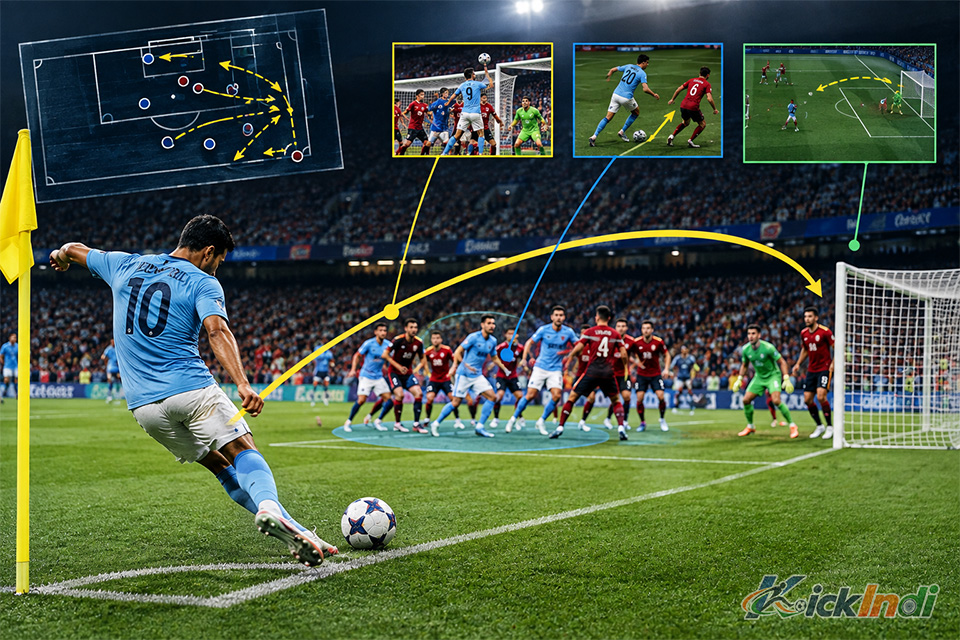
At the highest level, corners are now rehearsed attacking sequences involving blockers, decoy runs, delivery zones, screen movements, defensive manipulation and carefully selected targets. For teams competing in the Premier League, UEFA Champions League and major Asian competitions, a well-designed corner can create one of the few moments in which an attacking side can organise its players before the ball is put into play.
This is why football corner kick tactics and set piece analysis have become increasingly important for coaches, analysts, supporters and bettors.
The numbers support that trend. Opta’s analysis of recent Premier League seasons shows that corners have generally accounted for a growing share of goals, while the 2024-25 campaign produced a notable volume of corner-related attacking output. In one analysis of that season, Arsenal led the league for several corner metrics, including shots following corners and expected goals generated from them.
The important lesson is simple: a corner is not merely a cross. It is a structured attacking phase.
1. The Anatomy of a Modern Corner Routine
A successful corner usually contains three connected elements: delivery, movement and occupation of space.
Delivery
The first decision is where the ball should arrive. Common targets include:
- The near-post corridor
- The central six-yard area
- The far-post zone
- The area between the penalty spot and six-yard box
- A short-corner combination
The choice depends on the attacking team’s aerial strength, the goalkeeper’s positioning and the defending team’s marking system.
An inswinging corner can attack the goalkeeper’s decision-making because the ball travels towards goal. An outswinger can create a better attacking angle for a powerful header moving towards the target.
Movement
Elite teams rarely allow their attackers to stand still.
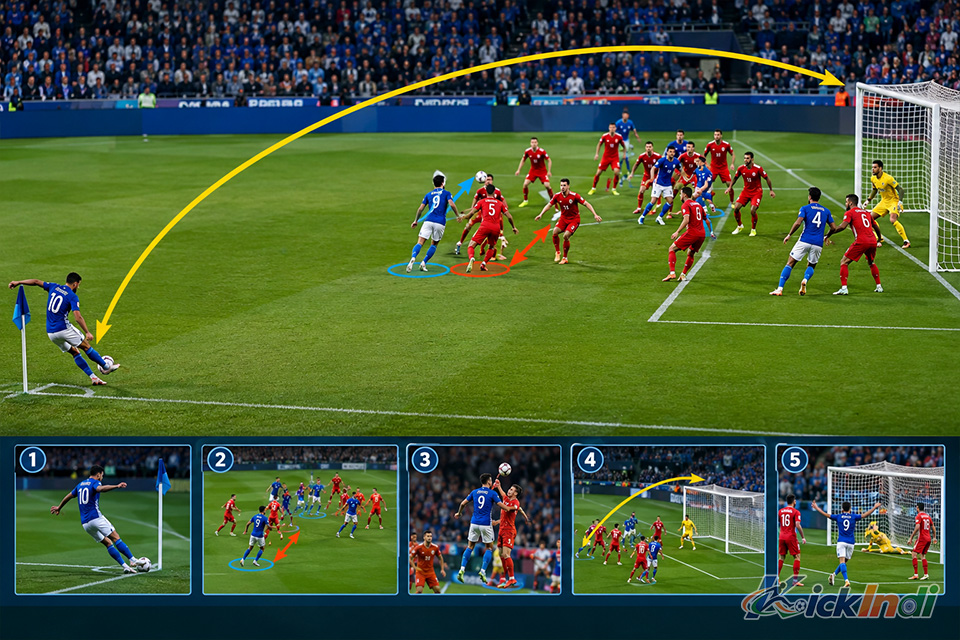
One player may sprint towards the near post while another delays his run towards the penalty spot. A third attacker can move across a defender to create a temporary screen. The purpose is not necessarily to make the first runner the target; sometimes that run exists solely to move two defenders away from the intended receiver.
Space Occupation
The final component is geometry.
If four attackers occupy the six-yard box, defenders must decide whether to follow individual players, defend zones or combine both systems. Every movement therefore creates a secondary consequence.
This is the foundation of modern set-piece coaching: manipulate the defensive structure before manipulating the ball.
2. The Most Effective Corner Kick Routines in Football
There is no universally perfect corner routine. Effectiveness depends on the players available, opposition structure and match situation.
However, several patterns repeatedly appear in elite football.
Near-Post Flick-On
The first attacker attacks the near-post area and attempts to redirect the delivery towards the far post.
The routine works because the initial touch changes the direction and speed of the ball, making it difficult for defenders and goalkeepers to react.
It is particularly dangerous when a team has a strong near-post runner and a second aerially dominant player attacking the far-post zone.
Far-Post Overload
Several attackers initially position themselves centrally before making staggered movements towards the far post.
The objective is to force defenders to track multiple runners simultaneously. The delivery then targets the player who gains separation.
This pattern is especially useful against teams that defend corners with a hybrid man-marking and zonal system.
Screen and Block Routine
A defender or midfielder moves across the path of a marker immediately before the delivery.
The action must remain within the Laws of the Game, but legal screens can still create enough separation for a team-mate to attack the ball.
This explains why some corner goals appear deceptively simple on replay. The decisive action may have occurred several metres away from the eventual scorer.
Short-Corner Rotation
Two players begin near the corner flag and exchange the ball before attacking the box.
The advantage is that it can temporarily remove a defender from the penalty area and alter the opposition’s defensive shape.
However, short corners are not automatically superior. Premier League data has shown that teams’ use of short corners can vary substantially by season and tactical trend.

3. How Teams Create Goals from Set Piece Corners
Understanding how teams create goals from set piece corners requires looking beyond the final header.
Consider a typical sequence:
Positioning → Decoy Movement → Defensive Disruption → Delivery → First Contact → Second Ball → Finish
Each stage can determine the outcome.
A team may place its tallest centre-back near the penalty spot. The defence naturally watches him. At the same time, a smaller but quicker attacker starts deeper and accelerates towards the near post.
The delivery is then played into the runner’s path.
If the first attacker wins the duel, the sequence can produce a direct shot. If he fails to make clean contact, another attacker may attack the loose ball. Therefore, good set-piece design does not necessarily depend on one player winning one duel.
It creates multiple probability pathways.
This is one reason analysts increasingly use expected goals, first contacts, shots after corners and second-ball recoveries rather than simply counting goals.
4. What the Data Says: Premier League and Champions League
The following figures illustrate why competition context matters.
| Competition / Dataset | Key Corner or Set-Piece Finding | Tactical Significance |
| Premier League, 2024-25 | 58.8% of set-piece goals analysed by Opta came from corners | Corners were the largest set-piece source in the dataset |
| Premier League, recent seasons | Average corner-goal conversion across the seven seasons before 2024-25 was about 3.7% | Even elite corner routines remain relatively low-frequency scoring events |
| Premier League, 2024-25 | Arsenal recorded 11 corners yielding a goal in Opta’s analysis, including own goals | Highlights the value of repeated corner pressure |
| UEFA Champions League 2024-25 league phase | 16% of goals came from set plays, excluding penalties | Set pieces remained important but less dominant than open play |
| UEFA Champions League 2024-25 league phase | 11% of goals came from corners | Corner goals formed a significant subset of set-play scoring |
| AFC Champions League Elite 2024-25 | Corners supplied 39% of dead-ball goals analysed | Corner efficiency was particularly important in the Asian elite club competition |
Sources: Opta Analyst, UEFA Technical Analysis and AFC Champions League Elite Technical Report.
The contrast is instructive for Indian football audiences. A tactical principle that works in the Premier League cannot automatically be transferred to the UEFA Champions League or the AFC Champions League Elite.
Different leagues produce different defensive behaviours, physical profiles and corner volumes.
5. Why Arsenal’s Set-Piece Model Attracts So Much Attention
Arsenal have become one of the most closely studied examples of modern set-piece optimisation.
Opta reported that Arsenal averaged 3.9 players in the six-yard box for attacking corners in the relevant Premier League sample, the highest figure in the division at that time. The club’s approach also relied on varying starting positions and movements rather than repeatedly delivering the same ball to the same location.
The broader lesson is more important than Arsenal itself.
A set-piece system becomes difficult to defend when the opposition cannot identify the target before the ball is delivered.
If defenders know exactly where the ball will arrive, they can organise. If they must respond to several possible movements, the attacking team gains an informational advantage.
This is the real science behind sophisticated corner routines.
6. Football Set Piece Strategies: Corner Kick Breakdown
A useful football set piece strategies corner kick breakdown should evaluate both attacking and defensive factors.
Attacking Checklist
1. Delivery quality
Is the ball consistently entering a high-value zone?
2. First-contact quality
Which player is expected to make the first touch?
3. Runner timing
Are attackers arriving together or in staggered waves?
4. Blocking structure
Are screens creating legal separation?
5. Second-ball structure
Who is positioned outside the box to recover clearances?
6. Rest defence
How many players remain behind the ball to prevent a counter-attack?
The final point is increasingly important.
A corner is an attacking opportunity, but it can also become a transition risk. If five or six players enter the penalty area and the delivery is cleared, the opposition may immediately attack the space behind them.
Therefore, an effective corner routine must balance goal probability against transition security.

7. Reading Corner Tactics for Match Commentary and Betting Analysis
For bettors, corner analysis should not be reduced to asking which team has “more corners”.
The more useful questions are:
- How many corners does the team normally generate?
- How many are taken short?
- Where are deliveries targeted?
- How often does the first attacker make contact?
- How many shots follow corners?
- Does the opponent concede first contacts?
- Does the goalkeeper dominate aerial deliveries?
- Does the team protect against counter-attacks?
This distinction is crucial when analysing markets such as total corners, team corners or corner-related goals.
For example, a side producing many corners does not necessarily have an equally high probability of scoring from them. Opta’s historical data shows that only a small percentage of individual corners directly lead to goals, even during seasons when set-piece scoring is increasing.
Therefore, corner volume and corner quality are different variables.
For Indian football bettors following European competitions late at night, this distinction can be especially useful when evaluating live markets. A team generating repeated first contacts and shots from corners may be creating more meaningful pressure than a team simply accumulating corner counts.
8. The Indian Football Perspective
Set-piece analysis has particular relevance to Indian football.
Indian Super League and national-team matches often feature moments where physical duels, aerial ability and defensive organisation can significantly influence the outcome. For clubs operating with different squad budgets, set pieces can also provide a relatively controllable route to attacking production.
The tactical principles are transferable:
rehearsed movement + delivery precision + aerial timing + second-ball structure = repeatable attacking opportunity.
For Indian coaches and analysts, the challenge is to adapt the system to player profiles rather than copy European routines literally.
A 6’4″ centre-back, a fast near-post runner and a technically excellent corner taker produce a different tactical equation from a team built around smaller, mobile attackers.
The best routine is therefore not the most fashionable one. It is the routine that maximises the specific strengths of the squad.
9. The Future of Corner-Kick Analysis
The next stage of football analytics will move further beyond counting goals.
Tracking data can identify:
- Average starting position of each runner
- Distance travelled before first contact
- Defensive displacement
- Delivery trajectory
- Expected receiver position
- Second-ball probability
- Counter-attack exposure
This could allow analysts to evaluate whether a corner routine is genuinely repeatable or whether its success was driven by a small sample of finishing events.
The growing sophistication of set-piece coaching suggests that corners will increasingly be treated like rehearsed attacking plays rather than isolated crosses.
That development is already visible across elite football. Opta’s recent Premier League analysis found that set-piece goals had become an increasingly significant proportion of total scoring, while corner deliveries and short-corner usage were also changing as tactical trends evolved.
Final Verdict: Why the Corner Still Matters
The modern corner kick is a contest between space, timing, information and probability.
The delivery may last only a few seconds, but the preparation can involve detailed analysis of every defender, runner and goalkeeper.
That is why the most dangerous corner routines are rarely accidental. They are designed to create uncertainty, move defenders away from key zones and give the attacking player a favourable moment to make contact.
For Match Commentary readers, the next time a centre-back rises above the defence to score from a corner, the goal should not be viewed simply as a good cross and a good header.
Look at the movement before the ball arrived.
Look at who occupied the goalkeeper.
Look at which defender was pulled away.
Look at the second-ball positioning.
And, when evaluating the betting markets, look beyond the raw corner count.
That is where the real science behind football’s most lethal corner routines begins.




































 England

 Spain

 Italy

 Germany

 France

 Netherlands

 Portugal
 Brazil

 Belgium
Premier League has its own unique sytle — #DerbyDay...
What a talent the player is if they keep playing like this if they keep playing like this
Class act with that kind of intensity 🔥... 🤔
for his age. the player is world class. 👏