

Modern football has evolved from a game of raw physical prowess into a sophisticated chess match where spatial dominance dictates outcomes. Whether analyzing high-voltage fixtures in the Indian Super League (ISL) between tactical heavyweights like Mohun Bagan Super Giant and Mumbai City FC, or European blockbusters in the UEFA Champions League, the team that dictates the tempo in the central corridor invariably emerges victorious. To comprehend how elite managers outwit their opponents, we must dissect the mechanics of positional play (Juego de Posición) and its ultimate objective: central supremacy.
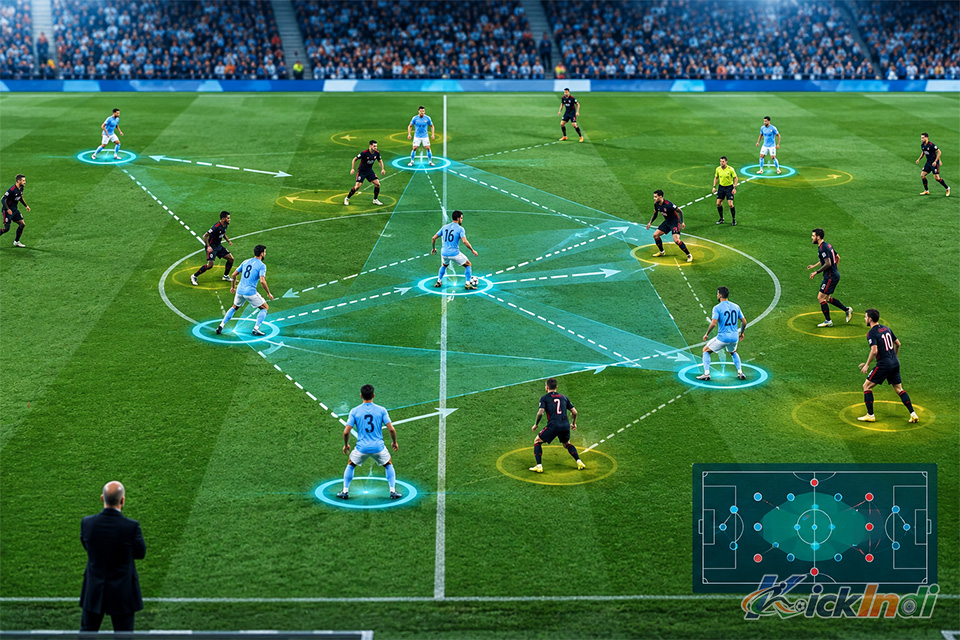
Deconstructing Central Dominance
At its core, what is midfield control in modern football tactics? It is not merely about accumulating a high possession percentage or completing sideways passes in safe areas. True midfield control is the systematic manipulation of space, time, and opponent structure. Elite tacticians utilize numerical and qualitative superiorities in the central zones to suffocate opposition counter-attacks and create progressive passing lanes.
When a team masters how positional play controls the midfield in soccer, they create invisible triangles and diamonds across the pitch. Players occupy specific functional roles—anchors, interior midfielders, and half-space orchestrators—ensuring that every vertical and horizontal channel has an active passing option. By pinning the opponent’s defensive and midfield lines deep, they open up crucial pockets of space between the lines where creative playmakers can orchestrate decisive attacking phases.

The Tactical Blueprint for Big Fixtures
High-stakes matches are rarely won through chaotic, end-to-end rushes; they are decided by structured patience and structural stability. Applying a comprehensive tactical guide to winning football matches through midfield dominance reveals that defensive security is actually born from offensive organization. When a team maintains proper spacing while in possession, losing the ball no longer triggers panic. Instead, immediate counter-pressing structures are already pre-configured because players are stationed in optimal recovery zones.
For instance, looking at recent tactical trends across domestic leagues and international championships, teams that successfully isolate the opposition’s pivot players completely disrupt the opponent’s transition game. By denying clean service to opposing creative midfielders, they force long, hopeful balls that are easily mopped up by central defenders.
| Tactical Phase | Primary Objective | Key Spatial Focus | Positional Discipline Required |
| Build-up | Draw opposition press & create free man | Defensive third & central corridor | High; maintaining strict passing triangles |
| Progression | Exploit half-spaces & break defensive block | Central midfield & opponent half-spaces | Moderate; dynamic rotation of interiors |
| Creation | Overload final third & isolate fullbacks | Penalty box perimeter & wide channels | Fluid; attacking runs matched by defensive cover |
| Rest-Defense | Prevent counter-attacks upon losing ball | Immediate central zone around the ball | Absolute; preventing central vertical progression |

Data-Driven Match Analysis
For analysts and enthusiasts tracking predictive metrics, evaluating structural efficiency goes far beyond standard box scores. Analyzing positional play strategies for soccer match analysis requires looking at metrics such as PPDA (Passes Per Defensive Action), line-breaking passes completed, and central territory occupation time.
Consider the statistical profile of elite midfields over recent marquee fixtures:
- PPDA Ratio: Winning sides typically register a lower PPDA (under 9.0), indicating aggressive, coordinated high pressing that forces hurried clearances.
- Line-Breaking Passes: Successful teams average upwards of 35 successful passes directly through the opponent’s midfield block per match.
- Spatial Retention: Dominant teams maintain more than 60% of their constructive possession sequences within central horizontal channels rather than sterile wide areas.

Concluding Thoughts
Ultimately, the battle for supremacy on the pitch is won long before the ball hits the back of the net. It is forged through meticulous tactical discipline, spatial awareness, and an uncompromising commitment to controlling the heart of the pitch. As tactical sophistication continues to grow globally and across Asian and Indian football ecosystems, mastering the nuances of positional play remains the ultimate differentiator between contenders and champions.Which modern manager do you think implements the most effective positional play system today?



























 England

 Spain

 Italy

 Germany

 France

 Netherlands
 Portugal
 Brazil

 Belgium
😎 Mohun Bagan are the real deal this season 💪
GG. if they keep playing like this.