

Indian football has witnessed remarkable strides over the past decade. The infrastructure is improving, the Indian Super League (ISL) has given a massive commercial boost, and fan engagement across platforms like KickIndi has touched unprecedented highs. Yet, a persistent and frustrating bottleneck remains: the lack of clinical goalscorers. When the national team steps onto the international stage, the same old narrative repeats—dominance in possession or gritty defensive displays, followed by a glaring inability to put the ball in the back of the net.
Understanding reasons behind Indian national football team goal drought is no longer just a tactical exercise; it is an urgent national priority. To break into the elite tiers of Asian football, Indian football stakeholders must systematically diagnose and solve the systemic finishing crisis.

Root Causes of the Scoring Drought
For years, analysts, pundits, and die-hard fans have debated why Indian strikers struggle in the final third. The issue goes far beyond simple lack of talent; it is deeply rooted in developmental pathways and tactical frameworks.
First, youth academies across the country have historically prioritized physical endurance and structural discipline over individual flair and instinctive boxcraft. Second, the heavy reliance on foreign strikers by top-tier ISL clubs means domestic forwards are routinely pushed to the wings or relegated to the bench during critical crunch moments. Consequently, when national team duty calls, players lack the ruthless composure required at the international level.
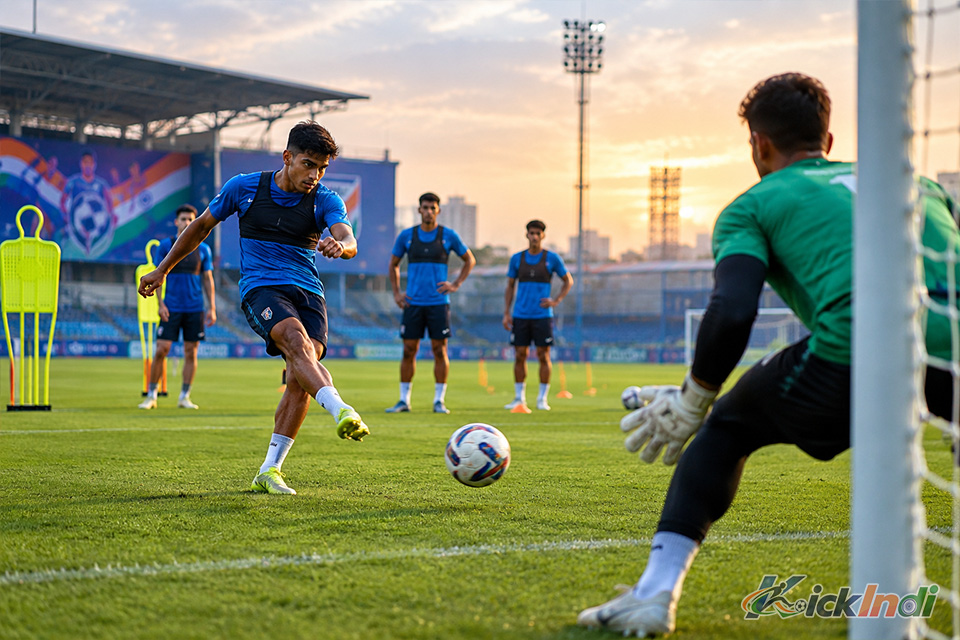
To turn things around, technical directors and coaches must actively evaluate how to solve india football team scoring problem through targeted finishing drills, modified small-sided games in academies, and exposure to high-pressure competitive scenarios.

Tactical Blueprint and ISL Integration
Solving the finishing dilemma requires a symbiotic relationship between domestic clubs and the national setup. The ISL serves as the ultimate breeding ground, but its current structural ecosystem often restricts young Indian talent from occupying central striking berths.
Implementing a robust developing young Indian football goalscorers strategy requires clubs to mandate specific minutes for domestic forwards in core scoring zones. Furthermore, specialized coaching staffs must be introduced to work exclusively on spatial awareness, first-touch redirection, and instinctive shooting under fatigue.
Crucially, Indian Super League young strikers finishing training must mirror the speed and physical intensity of continental tournaments like the AFC Asian Cup. Without bridging the gap between domestic match tempo and international intensity, our strikers will continue to rush their shots when given a fraction of a second inside the penalty box.
Comparative Performance Metrics
To quantify the finishing deficit, let us examine a comparative breakdown of conversion rates, shooting accuracy, and touches in the opposition box across different tiers of Indian football versus top Asian competitors over recent seasons.
| Metric / Parameter | Indian Super League (Domestic Forwards) | AFC Asian Cup Qualifiers (National Team) | Top-Tier Asian Competitors (J-League / K-League Avg) |
| Shot Conversion Rate (%) | 11.4% | 7.2% | 18.9% |
| Touches in Opposition Box (Per 90) | 14.2 | 8.6 | 22.4 |
| On-Target Accuracy (%) | 36.5% | 29.1% | 51.2% |
| Conversion from Inside 6-Yard Box (%) | 42.0% | 28.5% | 68.3% |
As the data vividly illustrates, the core issue is twofold: our national team struggles to generate high-frequency entries into the danger zone, and when they do get there, their conversion efficiency plummets drastically under pressure.

The Road Ahead: Actionable Reforms
Overcoming the finishing dilemma demands a collaborative roadmap involving the All India Football Federation (AIFF), club academies, and grassroots developers. We need a complete cultural shift in how young aspirants are coached from the under-13 level upward. Instead of prioritizing defensive rigidity to grind out tournament results, coaches must encourage calculated risk-taking, instinctive shooting, and 1v1 duels in the final third.
Moreover, leveraging advanced analytics—such as tracking Expected Goals (xG) metrics and shot-placement mapping—will allow coaches to pinpoint individual mechanical flaws in a striker’s shooting technique. By combining data-driven training regimens with traditional street-football creativity, Indian football can finally unearth and nurture the elite marksmen needed to propel the Blue Tigers onto the global stage.



















 England

 Spain

 Italy

 Germany

 France

 Netherlands

 Portugal
 Brazil

 Belgium
the player is overrated despite having more possession 😫
for his age... with that kind of intensity... with the talent they have... with their current form... Top league 😎