

In the modern landscape of association football, few elements divide opinion quite like officiating technology and match control. For Indian football fans tracking everything from the Indian Super League (ISL) to the English Premier League and UEFA Champions League, the flow of a game is just as vital as the final score. Match rhythm defines entertainment value, while the underlying numbers dictate tactical outcomes.
Introduction: The Invisible Hand of Officiating in Modern Football
Football is a game of relentless momentum. From the opening whistle to the final stoppage-time minute, the psychological and physical tempo of a match dictates how teams perform, how fans experience the spectacle, and how punters approach live markets. However, the introduction of technological interventions and strict disciplinary protocols has fundamentally altered this dynamic.
Understanding how VAR reviews impact live football match tempo and betting odds has become crucial for anyone looking beyond the surface of a 90-minute fixture. When matches are frequently halted for monitor reviews, the natural ebbs and flows of a team’s attack are interrupted, altering psychological momentum and creating unique shifts in live betting value.

Quantifying Disruption: How VAR and Match Officials Shape Tactical Flow
The psychological toll of officiating delays goes far beyond the immediate stoppage. When a referee halts play, players cool down, tactical instructions are hurriedly shouted from technical areas, and high-pressing teams often lose their physical intensity.
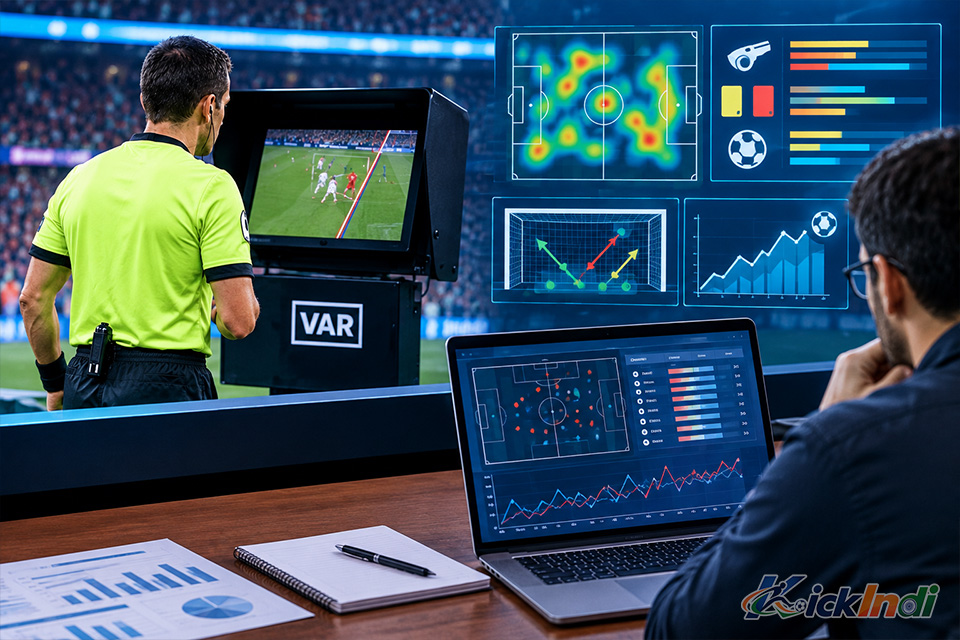
When evaluating these micro-narratives, analyzing referee decisions and VAR on goal expectations in football allows tactical analysts to see past raw possession stats. A referee who blows the whistle frequently for minor contact naturally lowers the expected goals (xG) accumulation rate by stopping sustained territorial dominance.
To visualize this disruption, consider how different refereeing styles impact match metrics over a 90-minute sample:
| Officiating Style / Metric | Strict / VAR-Heavy Matches | Flow-Oriented / Lenient Matches |
| Average Ball-in-Play Time | 52.4 Minutes | 61.8 Minutes |
| Average VAR Check Duration | 92 Seconds per check | Minimal / Play-on bias |
| First-Half xG Generation | Lower (Compressed momentum) | Higher (Sustained pressure) |
| Second-Half Fatigue Impact | Amplified due to stop-start rhythm | Balanced and progressive |
Breaking Down the Rhythm: Do VAR Interventions Slow Down Game Tempo and Lower Goal Totals?
A common debate among fans on Indian football forums and sports lounges is whether technology sterilizes the thrill of the game. Critics frequently argue that prolonged reviews kill stadium atmosphere and deflate player adrenaline.
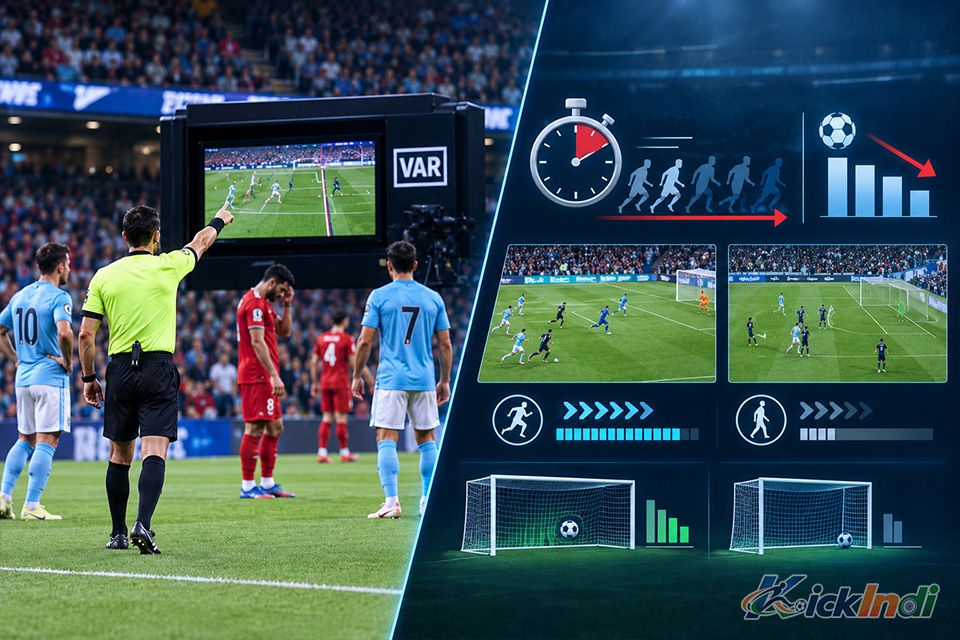
To answer the core question, do VAR interventions slow down game tempo and lower goal totals, we must look at empirical data across major leagues. Statistical reviews show that while total added time has increased globally (often exceeding 7 to 10 minutes per match), the quality of playing time changes. Extended pauses reduce high-intensity sprinting bursts immediately following restarts.
Consequently, teams heavily reliant on fast counter-attacks find their transitions neutralized. For goal expectations (xG), prolonged delays often act as a reset button for a defending team, allowing them to reorganize their defensive block, clear their lines, and ultimately reduce the probability of high-quality shot conversions.
Leveraging Officiating Metrics for Strategic Forecasting
For tactical analysts and data enthusiasts, referee tendencies should be treated with the same analytical weight as player injuries or home-advantage statistics. Officials carry distinct profiles: some are card-happy disciplinarians who disrupt rhythm early, while others prefer game management and verbal warnings.
By using referee stats and VAR trends for expert football match predictions, smart followers can find distinct value. For instance, matches overseen by referees with high penalty-award percentages combined with frequent VAR intervention historically yield higher total match goals, even if the general gameplay tempo feels sluggish. Conversely, strict whistlers who penalize every duel tend to depress total goal markets due to constant set-piece interruptions rather than open-play flow.

Conclusion: Balancing Accuracy and Flow
Ultimately, the marriage of refereeing authority and video assistance is here to stay. While the purists mourn the loss of uninterrupted flow, the pursuit of absolute rule enforcement remains paramount. For fans engaging with live games and strategic insights, acknowledging the invisible influence of the match official is no longer optional—it is the cornerstone of modern football intelligence.





































 England

 Spain

 Italy

 Germany
 France

 Netherlands

 Portugal
 Brazil

 Belgium
with that kind of intensity ngl Great game imo Huge fan of the team's style