

The landscape of elite association football has undergone a seismic shift over the past decade. Possession-dominant, tiki-taka blueprints have largely yielded to a hyper-efficient, vertical style of play. At the heart of this tactical revolution is the resurrection and refinement of the wide areas. Elite managers across Europe and domestic powerhouses in the Indian Super League (ISL) are increasingly abandoning rigid central build-ups in favour of blistering, flank-oriented transitions. This comprehensive tactical evaluation explores the structural mechanics driving this phenomenon, examining how modern transition systems rely fundamentally on wide operators.

Tactical Foundations of the Modern Transition
To understand the contemporary game, one must first deconstruct the evolution of defensive blocks. Modern defensive structures are notoriously compact, compressing space in Zone 14 and denying central progression through aggressive man-oriented pressing. Consequently, central attacking midfielders often find themselves starved of time and space.
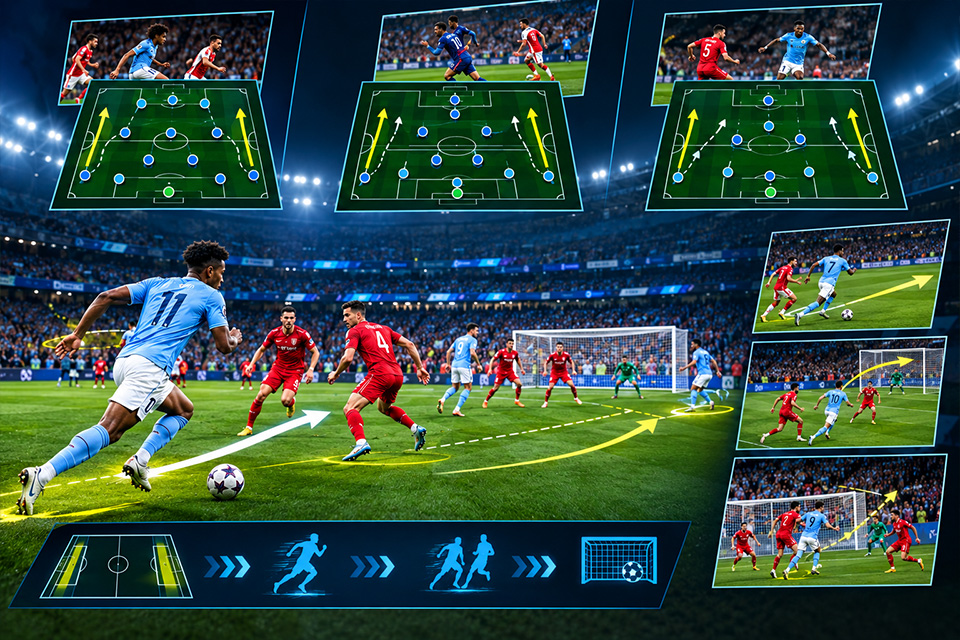
This defensive constriction has forced tactical masterminds to look outward. Flanks represent the highways of the modern pitch. By utilizing inverted wingers, wing-backs, and overlapping full-backs, teams create numerical superiorities in wide areas, stretching the opponent’s defensive line horizontally. When a turnover occurs, the transition from defence to attack is no longer about slow, methodical probing; it is an explosive, linear surge down the touchline. Analysts studying modern counter attacking tactics wing play system Premier League matches routinely highlight how quickly teams can transition from a low block into the final third by exploiting the space left behind by advanced opposition full-backs.

The Orchestration of Pace and Space
Transition football is fundamentally a game of seconds and spatial awareness. The traditional role of the winger as a mere touchline-hugger tasked with crossing has been entirely re-engineered. Today’s wide attackers function as primary playmakers and tactical conductors.
The influence of dynamic wide players is profound. When examining how wingers dictate the pace of modern counter attacking football, observers note that these athletes act as valves, controlling the tempo of the break. Upon regaining possession, the winger’s first touch is decisive—either driving forward at maximal velocity to pin the retreating defence or pausing momentarily to allow midfield runners to flood the box. Elite wide forwards possess the spatial intelligence to identify whether to cut inside into the half-spaces or burst down the outside for a cutback, turning every defensive clearance into an immediate crisis for the opposition.

Structural Blueprints: Formations and Width
Implementing an effective flank-based transition requires precise tactical shapes. Modern managers deploy specific structural frameworks designed to maximize recovery speed and offensive width simultaneously.
| Tactical Formation | Primary Width Mechanism | Transition Efficiency | Defensive Stability |
| 4-3-3 (Inverted) | Inverted Wingers + Overlapping Full-backs | Very High | Moderate |
| 3-4-2-1 / 3-4-3 | Dynamic Wing-Backs | Maximum | High |
| 4-4-2 (Flat/Diamond) | Wide Midfielders / Box-to-Box Rotations | Moderate | Very High |
A rigorous tactical analysis of wing play in modern transition football reveals that the 3-4-2-1 shape offers unprecedented flexibility. By utilizing wing-backs who can drop into a back five during defensive phases and detonate forward upon regaining possession, teams create dual threats on both flanks. This structural redundancy ensures that even if one side is neutralized by an opponent’s press, the weak-side winger remains isolated in a favourable one-versus-one duel.
Choosing the Ideal Tactical Framework
Selecting the right system depends heavily on squad profile, physical endurance, and high-intensity running capacity. For clubs aiming to build a sustainable, dominant counter-attacking model, certain frameworks consistently outperform others.
Deploying the best tactical formations for wing based counter attacking strategies often comes down to mastering the 4-3-3 variant with high-pressing wide forwards. In this setup, the front three act as the first line of defence, setting traps wide rather than centrally. When the ball is won, the distance to goal is minimized, and the wingers are already oriented towards the opposition penalty box, eliminating wasted touches and maximizing expected goals (xG) conversion rates.
Match Review and Implications for Indian Football
As Indian football continues its rapid upward trajectory, the adoption of sophisticated transition systems has become crucial for clubs competing in the ISL and continental tournaments. Indian fans, who increasingly consume high-level European leagues alongside domestic fixtures, demand tactical sophistication and high-octane entertainment. Understanding these intricate wide-play mechanics not only elevates the fan viewing experience but also provides deeper insights into post-match analyses, expert predictions, and strategic match outcomes.
What are your thoughts on how modern wing play is shaping the future of football? Drop your comments below and join the debate!




































 England

 Spain

 Italy

 Germany
 France

 Netherlands

 Portugal
 Brazil

 Belgium
🤔 the player is decent but nothing special the team need to be more consistent...